THE TOP THINKER THE FUTURE IS NOT WAITING FOR PERMISSION James W. Jenkins | The Visionary Behind a New Era of Thinking An extraordinary story of transformation, intellectual independence, leadership, and one man's determination to challenge the way the world thinks. SPECIAL EDITION | NOVEMBER–DECEMBER 2026 By The Visionary Editorial PROLOGUE: A MESSAGE FROM THE FUTURE THE YEAR IS 2036. Somewhere in America, a young student receives a disappointing grade. Instead of declaring defeat, she asks herself a question: What am I missing, and what can I do differently? Across the country, a corporate executive faces a crisis. The numbers are falling. Employees are frustrated. The pressure is mounting. But instead of searching for someone to blame, the executive gathers the team and asks: What is the real problem, and how do we solve it? Elsewhere, a father and son sit across from one another after years of misunderstandings. Neither is attempting to win the argument. For the first time, both are attempting to understand it. Three people. Three entirely different circumstances. One revolutionary connection. They have learned to think beyond the problem. This is not a report from 2036. It is a glimpse of the future one visionary is working to make possible. And the man behind that vision? His name is James W. Jenkins. But his story begins long before the world is invited to understand his method. Every generation produces individuals who challenge the established order. Some challenge technology. Others challenge politics, education, business, or the boundaries of human achievement. And then there are those who challenge something far more fundamental. The way human beings think. James W. Jenkins belongs to that conversation. An award-winning author, entrepreneur, and creator of The THINKER Method™, Jenkins has positioned his work around a deceptively simple question: What would happen if individuals were taught to approach life's challenges with greater ownership, strategic thinking, and personal accountability? It is a question with enormous implications. Not because complaining is unusual. Quite the opposite. Complaining is universal. It crosses every border, culture, profession, economic class, and generation. It exists in boardrooms and classrooms, in marriages and friendships, in political institutions and neighborhood conversations. And sometimes, complaints are entirely justified. They expose unfairness, reveal institutional failures, and identify problems that deserve attention. But Jenkins's work enters the conversation at a critical intersection. What happens after the complaint? Does frustration become paralysis? Does disappointment become identity? Does blame become a permanent substitute for responsibility? Or can the mind be trained to recognize the problem, understand its causes, and take meaningful action? That is where his vision begins. Not by pretending problems do not exist. But by refusing to allow problems to dictate the limits of human potential. THE MOST POWERFUL REVOLUTIONS ARE NOT ALWAYS LOUD. Some arrive without crowds. Without speeches. Without a single protest sign. They begin quietly, inside a human being who decides that yesterday's way of thinking will no longer govern tomorrow's possibilities. Jenkins's book, The Complainer and The Thinker, introduced the philosophical foundation for a much larger undertaking. What began as an exploration of human attitudes, accountability, and behavioral choices has evolved into the framework for a developing leadership and education initiative. Its foundation is known as The THINKER Method™. Seven principles define its approach: Take Ownership. Honor Principles. Identify the Real Problem. Navigate Challenges Strategically. Keep Learning. Execute Consistently. Review and Refine. Read them quickly, and they appear straightforward. Examine them carefully, and something more substantial emerges. They demand that individuals abandon the comfort of passive observation and become active participants in shaping their circumstances. They challenge leaders to become responsible for more than their titles. They challenge students to recognize learning as a process rather than a verdict. They challenge families to replace destructive cycles with more constructive communication. And perhaps most importantly, they challenge individuals to understand that intelligence alone is insufficient. Intelligence without execution is merely unrealized potential. That distinction sits near the center of Jenkins's philosophy. Thinking must eventually become action. Action must be evaluated. And progress must become a process that can be repeated. HERE IS WHERE THE STORY CHANGES. Because the most compelling element of Jenkins's journey is not the collection of awards. It is not the publishing contracts, developing educational materials, or plans for technological expansion. It is the contradiction that makes the entire undertaking profoundly human. The man developing a system for personal transformation has had to fight for his own. His journey has included uncertainty, financial hardship, unemployment, and periods of rebuilding. He has spoken openly about his sobriety and the personal discipline required to sustain more than a decade of recovery. There have been moments when the distance between his ambitions and his circumstances must have appeared enormous. Yet his professional identity has never been limited to a single occupation. With decades of experience as a licensed hairstylist, Jenkins has also pursued creative writing, entrepreneurship, and professional development. In 2026, while advancing his publishing and educational ambitions, he returned to the classroom to pursue his Class A commercial driver's license, with graduation anticipated in January 2027. Consider the symbolism. A man building a leadership organization is simultaneously preparing for another demanding profession. A man teaching accountability continues to submit himself to instruction. A man writing about resilience continues to practice it. There is something important in that contrast. It removes the illusion that visionaries must first achieve perfect circumstances. Perhaps the opposite is true. Perhaps vision is most meaningful when exercised in the absence of guarantees. Because a visionary is not necessarily someone who has already arrived. A visionary is someone who can see a destination clearly enough to keep moving when the road is uncertain. And Jenkins is still moving. There is a moment in the life of certain ideas when they begin to exceed their original purpose. A manuscript becomes a philosophy. A philosophy becomes a framework. A framework becomes a system. And a system begins asking whether it can serve people far beyond the individual who created it. That is the transition currently unfolding around The THINKER Method™. Jenkins envisions a connected educational and leadership ecosystem serving businesses, schools, families, communities, and individuals seeking meaningful personal development. Its developing components include educational books and age-specific curricula, instructor resources, corporate leadership programs, professional development materials, interactive experiences, and planned digital learning applications. But the larger ambition is not simply to distribute information. It is to create an environment in which thinking becomes a practiced discipline. Imagine a classroom where ownership is taught alongside academic achievement. Imagine a workplace where solving problems becomes more valuable than assigning blame. Imagine families developing shared language for responsibility, conflict, and personal growth. Now imagine those principles moving across generations. A child learns them. A teacher reinforces them. A parent applies them. A future executive builds upon them. This is the scale of Jenkins's vision. Its success will ultimately depend on execution, collaboration, resources, and measurable results. Those are significant challenges. But ambitious systems are not built by imagination alone. They require precisely the qualities the THINKER framework seeks to teach. And therein lies an unusual test of its creator: Can a philosophy built around consistent execution demonstrate that same consistency as it grows? The answer will be written by what Jenkins builds next. In 2026, Jenkins's expanding body of work received notable recognition. The Complainer and The Thinker earned recognition through the International Impact Book Awards, including honors in Business of Substantial Practice and Environmental Leadership. Jenkins was also named a finalist for Author of the Year 2026. His creative portfolio includes the award-winning works Reductionism and Unifying Theory, reflecting interests that extend beyond leadership nonfiction into broader literary and storytelling disciplines. He also received a 2026 Global Recognition Award for Innovation. These distinctions represent important milestones. But awards present their own philosophical challenge. They celebrate what has already been accomplished. Vision demands attention to what remains unfinished. For Jenkins, the question is no longer simply whether his ideas can earn recognition. It is whether those ideas can be developed into educational experiences, institutional partnerships, and practical tools that help others. The movement from recognition to responsibility may be the most important transition of all. An award can recognize an idea. Only implementation can demonstrate its impact. THE SYMPHONY OF POSSIBILITY DECEMBER 5, 2026. The Susquehanna Symphony Orchestra prepares for an evening of music. Musicians will take their places. Instruments will be tuned. Individual notes will eventually become something no single musician could produce alone. And among those attending the concert, Jenkins plans to introduce visitors to his books and The THINKER Method™ through his participation as a vendor. At first glance, an orchestra and a leadership-development initiative may appear to have little in common. Look closer. A symphony requires discipline. It demands preparation. Each musician must understand a role, listen to others, and recognize the importance of timing. No instrument can dominate every moment. No individual performance can replace the necessity of coordination. Excellence emerges through the combination of individual responsibility and collective execution. The parallel is striking. Organizations are made of people. Families are made of people. Communities are made of people. And just as the success of an orchestra depends upon how its individual members contribute to a shared composition, human progress depends upon how individuals think, communicate, and act together. A visionary does not need to play every instrument. A visionary must understand how different instruments can create something greater together. That December evening will not determine the future of Jenkins's organization. But it represents another opportunity to introduce the vision to a community. Another conversation. Another connection. Another note in a composition still being written. NOW RETURN TO 2036. To the student. The executive. The father and son. Remember those three scenes? They were never intended as predictions. They were questions about possibility. Could a different way of thinking improve a single decision? Could better decisions transform relationships? Could healthier organizations influence communities? Could practical education create opportunities that otherwise might never exist? These questions deserve serious exploration, not easy promises. No single method will eliminate adversity. No philosophy can guarantee success. And no visionary can claim ownership over the future. But meaningful progress often begins with individuals willing to challenge assumptions that others have accepted as permanent. That is the territory Jenkins has chosen to explore. His work is not yet a finished monument. It is an evolving blueprint. His organization is not a completed institution. It is a developing ecosystem. And his personal journey is not a polished story in which every obstacle has disappeared. It is an ongoing demonstration of the difficulty—and necessity—of continuing to build. Perhaps that is what makes the title The Top Thinker compelling. Not the suggestion that one individual thinks more brilliantly than everyone else. But the proposition that thinking deserves a more prominent place in how society defines leadership, achievement, responsibility, and human potential. After all, history rarely changes because everyone agrees with the present. It changes because someone recognizes that the present does not have to be permanent. And somewhere between the discomfort of today's realities and the possibilities of tomorrow, James W. Jenkins continues his work. Writing. Learning. Building. Questioning. Refining. Moving forward. Not because the future has promised him success. But because he understands something that cannot be measured by awards, contracts, or recognition. The future does not belong exclusively to those who can imagine something extraordinary. It must also be built by those willing to do the ordinary work required to make it possible. And for a man whose life's work challenges people to move from complaint to thoughtful action, there may be no greater measure of success than that. THE THINKER James W. Jenkins Award-Winning Author | Visionary | Creator of The THINKER Method™ “Transform Minds. Build Leaders. Create Legacies.™” THE THINKER METHOD™ ?? www.thethinkermethod.org EDITOR'S CLOSING THOUGHT What if the greatest invention of the next generation is not a machine, an application, or a technological breakthrough—but a better way for human beings to think? That is the question at the heart of The THINKER Method™. And its answer is still being written.
Leadership • Education • Family Development • Innovation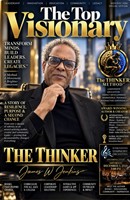
JamesJenkinsAuthorLLC/LiteralExcellenceusa.org
James Jenkins Founder