What If Better Thinking Became a Business Strategy? The question corporate leaders may need to ask before their next strategy meeting By James W. Jenkins Companies spend enormous amounts of time talking about strategy, innovation, productivity, leadership development and organizational culture. But there is a question that may come before all of them: How well does the organization actually think? Not how intelligent its executives are. Not how impressive the résumés around the conference table appear. Not how much data appears in the quarterly presentation. The deeper question is what happens when something goes wrong. A major client walks away. Revenue misses projections. A product launch fails. Employee engagement declines. Two departments blame each other for an important deadline that was missed. What happens next may reveal more about an organization's future than its mission statement ever could. Does the conversation become: "Whose fault is this?" Or does someone change the direction of the room by asking: "What is the real problem—and what are we going to do about it?" That difference may appear small. It isn't. It can represent the difference between a culture that reacts and one that thinks. The Most Expensive Problem In The Boardroom May Be The One Nobody Measures Businesses measure almost everything. Revenue. Expenses. Customer acquisition. Productivity. Retention. Market share. Employee performance. Return on investment. But organizations rarely put a number on the cost of poor thinking. What does defensiveness cost? What does blame cost? What does a decision delayed because nobody wants responsibility cost? What does it cost when an employee recognizes a problem but remains silent because the corporate culture has taught them that exposing problems is dangerous? And perhaps most importantly, what does it cost when leaders repeatedly solve the symptoms of problems without identifying their causes? Those costs may never appear as a single line on a financial statement. They appear somewhere else. Turnover. Lost opportunities. Duplicated work. Missed deadlines. Internal conflict. Failed execution. Poor customer experiences. And eventually, declining performance. This raises an interesting possibility: What if better thinking itself became part of business strategy? From Motivation To Method That question sits at the center of The THINKER Method™, a leadership and organizational development framework I created around seven principles: T — Take Ownership H — Honor Principles I — Identify the Real Problem N — Navigate Challenges Strategically K — Keep Learning E — Execute Consistently R — Review and Refine Taken separately, these concepts may sound familiar. Their potential power comes from connecting them into a repeatable cycle of organizational behavior. Ownership → Principles → Diagnosis → Strategy → Learning → Execution → Refinement. Then the process begins again. The objective is not positive thinking. It is productive thinking. Imagine The Monday Morning Meeting Consider a hypothetical company that has just lost one of its largest accounts. The traditional meeting can quickly become an exercise in corporate self-preservation. Sales questions marketing. Marketing points toward customer service. Customer service says the product failed to meet expectations. Operations explains that expectations were unrealistic from the beginning. Everyone may possess part of the truth while the organization gets no closer to solving the problem. Now imagine changing the questions. What do we own? What principle should guide our response? What is the actual problem? What options do we have? What can this teach us? What are we going to execute? When will we review the result? Same company. Same employees. Same lost account. Completely different conversation. That is where culture becomes operational. Accountability Without The Culture Of Blame Corporate leaders often say they want accountability. Employees sometimes hear something different: Someone is going to be punished. When accountability becomes synonymous with punishment, organizations can unintentionally teach employees to protect themselves rather than expose problems. True accountability should create clarity. Taking ownership does not necessarily mean declaring, Everything is my fault. It means asking: What portion of this outcome can I influence, correct or improve? That distinction matters. A workplace where employees are afraid to admit mistakes can hide problems. A workplace where mistakes carry no responsibility can repeat them. High-performing cultures need something between those extremes: environments where people can confront reality while still being expected to act on it. The CEO Should Not Be The Only THINKER In The Room There is another danger in leadership culture: organizations can become dependent on a handful of decision-makers. Every significant problem travels upward. Every answer requires executive approval. Employees become excellent at identifying problems but increasingly dependent on leadership to solve them. That is not necessarily leadership development. It may be leadership dependency. The more interesting possibility is an organization in which thinking becomes distributed. Imagine a frontline employee identifying the real problem before escalating it. Imagine a manager arriving at an executive meeting with potential solutions rather than only complaints. Imagine departments reviewing failures without immediately building defenses around themselves. Imagine employees being trained not simply to follow instructions but to evaluate, execute and refine. The competitive advantage would not merely be having one extraordinary thinker at the top. It would be developing hundreds or thousands of better thinkers throughout the organization. What Would Change In The Boardroom? This is where the conversation becomes larger than a leadership seminar. What if organizations treated thinking as a capability that could be developed, practiced and eventually embedded into culture? A board might begin asking different questions. Instead of: Who made this mistake? It might ask: What system allowed this mistake to reach this level? Instead of: Why aren't employees performing? Leadership might ask: Have we clearly identified what is preventing performance? Instead of: Why isn't the strategy working? Executives might ask: What have the results taught us that requires refinement? These questions do not eliminate accountability. They strengthen it. Because the conversation ultimately has to arrive at execution. Someone must own the next action. Someone must establish the objective. Someone must measure the outcome. And the organization must be willing to return to the result and ask whether its thinking was correct. Culture Is Built In The Response Corporate culture is often described through carefully selected words: Innovation. Integrity. Excellence. Collaboration. Accountability. But culture may be revealed more accurately by what happens five minutes after something goes wrong. Who speaks? Who becomes defensive? Who stays silent? Who searches for someone to blame? Who searches for the truth? And who finally says: "Here's what we're going to do next." Those moments build organizations. They teach employees what leadership actually means inside that company. A poster can announce values. A crisis reveals them. The Business Case For Better Thinking Artificial intelligence is changing how organizations process information. Automation is changing how work gets completed. Data is becoming faster and increasingly accessible. That makes human judgment less important only if we assume information and judgment are the same thing. They aren't. Technology can provide more information. Leadership must still determine which problem matters. Technology can generate possibilities. People must still evaluate consequences. Technology can accelerate execution. Organizations must still decide what deserves to be executed. The future of leadership therefore may not simply belong to companies possessing the most technology. It may belong to organizations capable of combining powerful technology with disciplined human judgment. The Question I Want Executives To Consider The THINKER Method™ grew from a simple observation about human behavior: complaining identifies discomfort, but thinking creates direction. Organizations need people who can identify what is wrong. But identification cannot be the destination. The challenge is moving people from: reaction to responsibility, from responsibility to understanding, from understanding to strategy, and from strategy to execution. Then organizations must have enough humility to review the result and improve again. That cycle never really ends. Neither does leadership. So perhaps the next great corporate transformation does not begin with another piece of software, another slogan or another hundred-page strategic plan. Perhaps it begins with a question around a conference table. What happens when better thinking enters the boardroom? Better conversations can create better decisions. Better decisions can create stronger accountability. Stronger accountability can create stronger teams. Stronger teams can build stronger organizations. And stronger organizations can create something quarterly earnings alone cannot measure: legacy. Transform minds. Build leaders. Create legacies.™ James W. Jenkins is an author, entrepreneur and creator of The THINKER Method™, a leadership and organizational development framework focused on accountability, problem-solving, strategic execution and continuous improvement. ?? TheTHINKERMethod.org — Coming Soon James W. Jenkins #TheTHINKERMethod #LeadershipDevelopment #CorporateLeadership #WorkplaceCulture #ProfessionalDevelopment #Accountability #ProblemSolving #OrganizationalDevelopment ?? COMING SOON ?? TheTHINKERMethod.org
Creator of The THINKER Method™
Responsibility begins before improvement can.
Decisions should remain connected to values, integrity and organizational purpose.
Organizations cannot consistently solve problems they have incorrectly defined.
Problems require thoughtful responses, not simply emotional reactions.
Organizations must be willing to learn from results, failures, people and changing environments.
Ideas have limited organizational value until they become action.
Execution should produce information that improves the next decision.
Transform Minds. Build Leaders. Create Legacies.™
Author • Creator of The THINKER Method™
The Complainer and The Thinker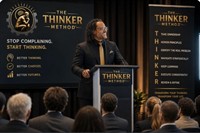
JamesJenkinsAuthorLLC/LiteralExcellenceusa.org
James Jenkins Founder

