WHEN SUCCESS DISAPPEARS, WHAT’S LEFT?
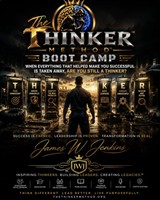
Inside THE THINKER METHOD™: BOOT CAMP — A Television Concept Designed to Put Leadership Under Pressure
Created by James W. Jenkins Creator, The THINKER Method™ Award-Winning Author & Entrepreneur
Success can tell us a great deal about a person.
But pressure may tell us more.
What happens when the executive office is gone? When there is no assistant handling the details, no luxury vehicle waiting outside, no familiar team to solve the next problem, no professional title commanding immediate respect, and no easy access to the resources that normally make success easier to maintain?
When everything that helped make you successful is taken away, are you still a THINKER?
That question sits at the center of THE THINKER METHOD™: BOOT CAMP, an unscripted television concept created to transform the principles of The THINKER Method™ from something audiences can read about into something they can experience, witness, debate, and ultimately apply to their own lives.
This is not simply another reality television competition.
It is a test of what remains when achievement meets disruption.
And more importantly, it is an exploration of whether accomplished people can change.
FROM PHILOSOPHY TO EXPERIENCE
The THINKER Method™ began with a straightforward philosophy: complaining does not solve problems.
Progress begins when individuals take responsibility for what they can control, identify the real issue, develop a strategy, execute consistently, learn from what happens, and refine their approach.
Over time, that philosophy developed into a broader platform with applications across leadership development, education, family development, personal growth, publishing, workforce training, certification, products, and organizational culture.
But there is a difference between explaining transformation and watching transformation happen.
Television creates that opportunity.
THE THINKER METHOD™: BOOT CAMP would place accomplished executives, entrepreneurs, athletes, business leaders, public figures, and other high-performing individuals into controlled but demanding real-world environments where many of their normal advantages are temporarily removed.
For approximately 14 to 21 days, participants would voluntarily step away from selected conveniences associated with their everyday lives.
Executive support disappears.
Luxury accommodations disappear.
Personal staff disappear.
Easy access to money may be restricted.
Transportation may be limited.
Status may suddenly carry far less weight.
What remains is the person underneath the position.
SUCCESS UNDER PRESSURE
Participants would encounter challenges involving limited resources, unfamiliar environments, difficult decisions, communication failures, unexpected setbacks, team conflict, time-sensitive problems, accountability, adaptation, and execution.
The objective would never be humiliation.
The objective would be transformation.
That distinction matters.
The program would not exist to tear successful people down for entertainment. It would place them in circumstances designed to reveal how they think when familiar systems stop protecting them from friction.
Can they listen when they are no longer the unquestioned authority?
Can they admit they made the wrong decision?
Can they lead someone who does not automatically respect their title?
Can they remain disciplined when they are uncomfortable?
Can they become students again?
Can they distinguish the problem they see from the problem that actually needs to be solved?
That is where The THINKER Method™ becomes the engine of the experience.
THE SEVEN PRINCIPLES COME ALIVE
Every participant's journey would be built around the seven principles of The THINKER Method™.
T — Take Ownership
What happens when there is nobody else to blame?
Participants must confront the difference between explaining what went wrong and accepting responsibility for what happens next.
Ownership becomes the starting point.
H — Honor Principles
Pressure creates shortcuts.
When an easier solution appears, will participants sacrifice the values they claimed were responsible for their success?
Character becomes measurable when convenience disappears.
I — Identify the Real Problem
The most visible problem is not always the real one.
A failed task may actually be a communication problem.
A team conflict may actually be an ego problem.
A shortage of resources may actually expose poor planning.
Participants must learn to diagnose before reacting.
N — Navigate Challenges Strategically
Real life rarely delivers one problem at a time.
What happens when several things go wrong simultaneously?
Participants must prioritize, allocate resources, make decisions with incomplete information, communicate clearly, and keep moving.
K — Keep Learning
Success can create expertise.
It can also create certainty.
Boot Camp asks accomplished individuals to become students again—receiving instruction, adjusting behavior, learning unfamiliar skills, and accepting that yesterday's expertise may not solve today's problem.
E — Execute Consistently
Ideas matter.
Execution determines whether they become results.
Participants must continue performing when enthusiasm fades, conditions change, frustration rises, and nobody is applauding.
R — Review and Refine
The final discipline may be the most difficult.
Participants must examine their own decisions.
What worked?
What failed?
What did they misunderstand?
What did their behavior contribute?
And what must change before the next challenge?
That is where experience becomes growth.
The detailed challenge architecture and proprietary methodology behind the program would remain protected and would be developed further with appropriate production, product, licensing, and strategic partners.
THE ENTERTAINMENT ENGINE
At its core, every Boot Camp journey follows a powerful progression:
SUCCESS → DISRUPTION → PRESSURE → DISCOVERY → THINKER → REBUILD → PROOF
That progression creates the emotional engine of the series.
The audience is not merely told that a participant has changed.
They witness it.
They see frustration.
They see bad decisions.
They see arguments.
They see ego collide with reality.
They see leadership habits that may have remained hidden inside the comfort of an established career.
They also see breakthroughs.
A participant who initially blames everyone around them may eventually recognize their own role in a failed situation.
A highly accomplished executive may discover they have forgotten how to listen.
An entrepreneur known for taking risks may realize that instinct without reflection has become recklessness.
An athlete accustomed to personal performance may discover that leadership requires helping someone else succeed.
And at some point, one participant may arrive at the realization that represents the spirit of the entire series:
Maybe the problem wasn't everybody around me. Maybe I need to rethink how I lead.
That is television with consequences beyond the episode.
A DIFFERENT KIND OF REALITY PROGRAM
Many reality programs ask one basic question:
Who can win?
THE THINKER METHOD™: BOOT CAMP asks something different:
Who can change?
There does not need to be a million-dollar prize waiting at the end.
The transformation can be the reward.
Participants already arrive with accomplishments.
They may have wealth, recognition, credentials, influence, championship experience, leadership authority, or business success.
Boot Camp is not attempting to prove whether they have achieved something.
It examines the thinking underneath those achievements.
Because success and personal development are not always the same thing.
Someone can build a successful company and still struggle with accountability.
Someone can lead thousands of employees and still communicate poorly at home.
Someone can become famous and still react emotionally when their normal control disappears.
Someone can be brilliant at solving business problems and incapable of acknowledging their own mistakes.
Boot Camp creates a setting where those contradictions can no longer hide behind achievement.
THE REAL TEST COMES AFTERWARD
Transformation means very little if it disappears the moment the pressure ends.
That is why the story should not necessarily conclude when participants leave Boot Camp.
Each participant could return home or to their professional environment with a defined THINKER Action Plan based on what they learned.
Then, after an appropriate period, the program could revisit them.
Did their behavior actually change?
Did they communicate differently with employees?
Did they accept greater responsibility?
Did they approach conflict differently?
Did their decision-making improve?
Did their family notice?
Did their colleagues notice?
Did their leadership team notice?
Most importantly:
Did the THINKER transformation survive the return to success?
This creates one of the concept's most important potential differentiators:
PROOF OF TRANSFORMATION
The audience gets to see whether lessons learned under pressure become behaviors practiced in real life.
That follow-up takes the program beyond temporary inspiration.
It creates accountability.
TELEVISION AS THE FRONT DOOR
Boot Camp would not replace The THINKER Method™.
It could introduce it to a mass audience.
A viewer might encounter the philosophy for the first time through television and then discover an entire ecosystem behind it.
TELEVISION ↓ THE THINKER METHOD™ ↓ BOOKS & PUBLISHING ↓ LEADERSHIP & CORPORATE PROGRAMS ↓ EDUCATION ↓ FAMILY & LIFE DEVELOPMENT ↓ THINKER PRODUCTS & EXPERIENCES ↓ SPEAKING • LICENSING • CERTIFICATION
That is where the entertainment concept becomes strategically larger than entertainment.
The series can become a front door.
WHEN THE PRODUCTS BECOME PART OF THE STORY
One of the most interesting commercial possibilities surrounding Boot Camp is product integration that does not feel like conventional advertising.
Instead of placing products around participants simply because a sponsor paid for exposure, THINKER products could become functional components of the transformation.
A participant might receive a THINKER journal used for daily reflection.
Leadership cards could introduce specific decision-making challenges.
Assessment tools could track behavioral changes.
Workbooks could accompany each stage of the experience.
Digital tools could record goals, accountability measures, and performance.
The THINKER Box™ could become a physical representation of the program itself—containing selected materials, exercises, challenges, prompts, assessments, and development tools.
What begins as something participants use on television could eventually become something companies, educators, families, and consumers experience themselves.
Potential extensions could include:
The THINKER Box™.
Participant workbooks and journals.
Leadership challenge cards.
Corporate challenge kits.
Digital progress tracking.
Assessment tools.
Consumer Boot Camp experiences.
Educational adaptations.
Family experiences.
Licensed THINKER Method™ products.
The principle is simple:
The audience should not only be able to watch transformation. Eventually, they should be able to participate in it.
WHY PRODUCT DEVELOPMENT MATTERS
That commercial dimension is one reason the concept is particularly relevant to conversations with organizations such as Product Mentor.
The strategic challenge is bigger than creating merchandise around a television show.
The real question is:
How do we convert audience engagement into a scalable commercial ecosystem without weakening the underlying intellectual property?
That requires decisions about product strategy, commercialization, consumer experience, prototyping, manufacturing, packaging, licensing, market positioning, and brand expansion.
It also requires restraint.
The goal should not be to manufacture every possible THINKER product at once.
The goal should be to identify which products are authentic extensions of the Method, determine which ones strengthen the television experience, understand which ones can stand independently in the consumer marketplace, and establish the correct development sequence.
A prototype that strengthens a conversation with a television producer may be different from the product needed for a corporate leadership buyer.
A classroom version may differ from a family version.
A consumer THINKER Box™ may eventually differ from the materials used during Boot Camp itself.
Developing that architecture correctly is what allows intellectual property to become a brand rather than a collection of unrelated products.
THE COMMERCIAL QUESTIONS WORTH ASKING
The next stage of development should explore several important questions:
Which physical products naturally belong inside the television experience?
Which of those products could become consumer versions of that experience?
How should The THINKER Box™ connect entertainment, leadership training, education, family development, and direct consumer engagement?
Which concepts deserve prototypes first?
Which prototypes would strengthen discussions with television producers, licensing partners, corporate buyers, manufacturers, or investors?
And how can commercial expansion occur while protecting the proprietary structure of The THINKER Method™ itself?
Those questions matter because the greatest opportunity may exist at the intersection of several industries rather than inside only one.
CONTENT + EXPERIENCE + TRANSFORMATION + PRODUCTS
The larger vision is not another reality show.
It is not another motivational product.
It is not another leadership seminar.
The opportunity is the connection between them.
CONTENT + EXPERIENCE + TRANSFORMATION + PRODUCTS
A viewer watches someone confront a THINKER challenge.
A company brings that same principle into leadership development.
An educator adapts it for students.
A family practices it at home.
A consumer experiences it through a THINKER product.
A professional pursues certification.
A participant applies the Method to a real organization.
The television property introduces another audience.
And the ecosystem continues expanding.
That is how an idea can move beyond content.
It becomes an experience.
And eventually, an experience can become a culture.
THE CREATOR BEHIND THE CONCEPT
James W. Jenkins is the creator of The THINKER Method™, an award-winning author, entrepreneur, and developer of intellectual property spanning publishing, leadership, education, personal development, and product concepts.
The THINKER Method™ grew from a demanding but practical belief:
Problems do not disappear because we complain about them.
Progress begins when we take ownership.
Then we identify what is actually wrong.
We develop a strategy.
We execute.
We learn.
We review.
And we refine.
Those principles can be written in a book.
They can be taught in a classroom.
They can be discussed in a boardroom.
But THE THINKER METHOD™: BOOT CAMP creates the possibility of watching them tested when pressure is real, resources are limited, emotions rise, and results still matter.
It takes the philosophy off the page and puts it into the world.
WHAT COULD THIS BECOME?
THE THINKER METHOD™: BOOT CAMP is not being presented as a completed television production.
It is being presented as an intellectual-property and commercial concept worthy of serious development.
Its future depends upon the right relationships across entertainment, product development, manufacturing, licensing, corporate partnerships, education, publishing, investment, and brand strategy.
The THINKER Method™ provides the philosophy.
Boot Camp provides the experience.
Product development can provide the tangible connection.
Entertainment can provide the audience.
The next question is how those pieces should be assembled.
Because perhaps the most important test of success is not whether someone can achieve it once.
Perhaps the real test is what remains when the things surrounding that success disappear.
When everything that helped make you successful is taken away, are you still a THINKER?
THE THINKER METHOD™: BOOT CAMP
Created by James W. Jenkins Creator, The THINKER Method™ Award-Winning Author & Entrepreneur
Transform minds. Build leaders. Create legacies.™
thethinkermethod.org
JamesJenkinsAuthorLLC/LiteralExcellenceusa.org
James Jenkins Founder

